
Teacher Voice Framework
Teacher wellbeing, from voice to HR action.
A research-informed framework that turns what teachers report into the two or three HR and leadership changes each school should make first.
Why it matters
Teacher wellbeing is a system responsibility, not a coping skill.
Workload, induction, appraisal and leadership shape how teachers feel and whether they stay. Schools need to see which of these to change, and in what order.
The framework
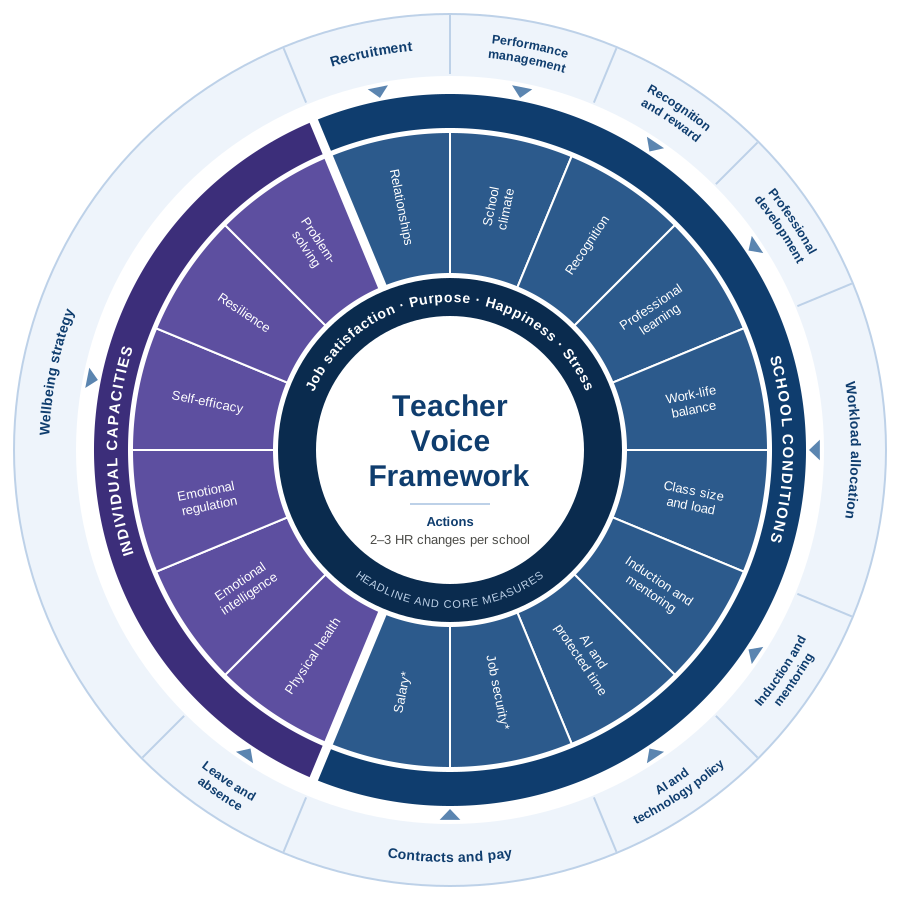
From teacher voice to HR action
Satisfaction
How satisfied teachers are
Wellbeing
Purpose, happiness, stress
Drivers · 16
Individual capacitiesSchool conditionsHR levers
10 processes that move the drivers
Actions
Teacher development plansHR and leadership actionsResults end in HR changes the school can make, not coping tips for individuals.
What shapes teacher wellbeing
10 of 16 drivers sit with the school
Individual capacities · 6
School conditions · 10
* Optional, offered per system.
From evidence to HR action
Practices school HR teams can adopt
With the strength of the evidence behind each.
- Strongrandomised trial
- Moderatequasi-experimental study
- Promisingcorrelational study with controls
- Rationalesound logic, impact not yet evaluated
No HR practice here reaches the Strong tier. Most evidence comes from the US and England, and very little tests HR practice directly. Measuring which practices a school has, alongside what its teachers report, is how this framework helps build that evidence in the region.
All evidence cited is external published research, not BuzzGage data. Tiers are BuzzGage's reading of the cited studies.
How it works
Twice a year: listen, act, re-measure
- Step 1
Listen
A 15-minute teacher check-in and a short HR practice checklist.
- Step 2
Interpret
Find the two or three drivers that matter most for this school.
- Step 3
Act
Make two or three HR changes, with group plans for teachers.
- Step 4
Re-measure
Six months later, see whether the drivers moved.
What each school receives
Results for leadership, at school level.
The two or three changes to make first.
Group programmes, built on research.
Built for trust
Teachers answer honestly when it is safe to
- Results at school level only, for groups of 10 or more
- Never used in appraisal
- Turnover separates contract endings from resignations
Linked to student voice
Teacher and student views, read together
In schools already hearing from students through BuzzGage, teacher results are read alongside student wellbeing and engagement. Where the two differ, the whole-school conversation starts.
Research foundations
Built on published research
- Oxford Wellbeing Research Centre and IBOTeacher wellbeing reports (2024, 2025): definition and drivers
- De Neve, Kaats and Ward (2023)Workplace wellbeing measures: headline and core items
- OECD TALIS 2024Workload, induction, collaboration and AI
- EEF evidence reviewsLeadership, flexible working and retention
- UK DfE Education Staff Wellbeing CharterWellbeing strategy and workload
- Gallup and Walton Family Foundation (2025)AI and teacher time
The framework draws on this research. It is not endorsed by the authors or organisations cited.
Questions
Who takes part?
All teachers in the school. Results are only ever reported for the school as a whole, never for individuals.
How long does it take?
About 15 minutes, twice a year.
Which languages are available?
English, Arabic and Turkish.
How is teacher data protected?
Teacher data is handled in line with major data protection laws, including Qatar's Personal Data Privacy Protection Law (PDPPL), Türkiye's Personal Data Protection Law (KVKK), the UAE Personal Data Protection Law (PDPL), the EU General Data Protection Regulation (GDPR), and applicable US federal and state privacy laws. Results are reported for groups of 10 or more and are never used in appraisal.
Bring teacher voice into your school's HR decisions
Now available to schools and education systems, in English, Arabic and Turkish.